
Cinnamon Essential Oil
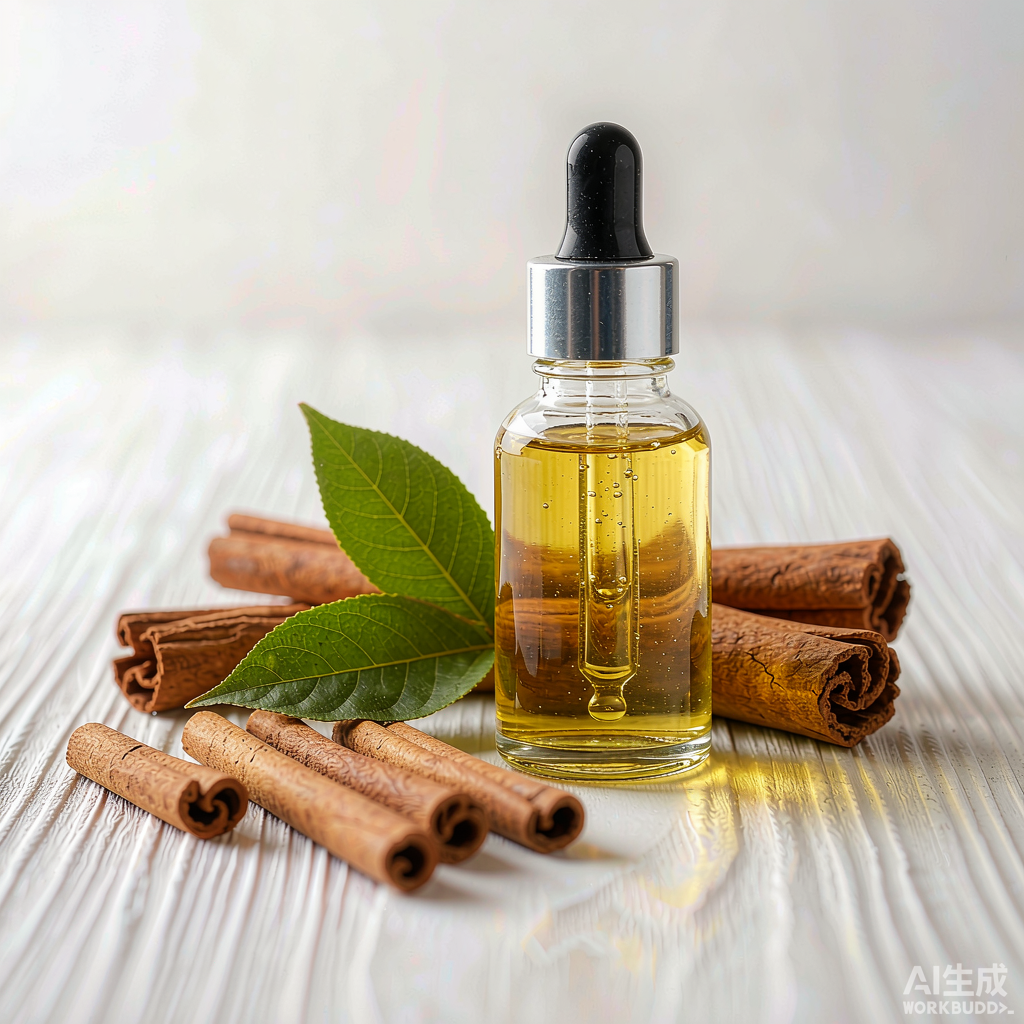
Cinnamon Essential Oil (CAS 8015-91-6, INCI name -distilled essential oil standardized to >85% cinnamaldehyde, distilled from Cinnamomum cassia bark. Baisifu supplies food-grade, BP/USP and Ph.Eur. equivalent batches from a Xi’an facility, with every drum shipped with a COA, allergen declaration and IFRA documentation.
Botanical identity and chemistry
Cinnamon Essential Oil is the steam-distilled volatile oil obtained from the dried bark of Cinnamomum cassia Presl (Chinese cassia), an evergreen laurel of southern Chinese origin. The oil is dominated by cinnamaldehyde, a phenylpropanoid aldehyde whose warm, sweet, spicy-bark character has made cassia oil a flavour and fragrance staple for centuries. Cassia bark oil is distinct from cinnamon leaf oil (lower aldehyde, higher eugenol) and from Ceylon cinnamon bark oil (C. verum); Baisifu supplies the cassia bark grade.
Distillation and standardisation
Dried bark is comminuted and charged to a stainless-steel still for steam distillation at atmospheric pressure; the yield typically runs 1 to 2 percent on a dry-bark basis. The crude oil is settled, filtered and standardised in-house to a minimum of 85 percent cinnamaldehyde by GC-MS against a pharmacopoeial reference standard. Baisifu does not dilute with synthetic cinnamaldehyde or blend in leaf oil; each drum is single-botanical-source cassia bark oil.
Active profile by GC-MS
The GC-MS fingerprint is anchored on the cinnamaldehyde peak, with a reproducible secondary cast of cinnamyl acetate, coumarin, 2-methoxycinnamaldehyde and trace eugenol. Baisifu records the complete chromatogram on every COA and rejects any batch whose coumarin level exceeds the food-use ceiling, because coumarin carries hepatotoxicity limits in food and beverage applications.
Physical and sensory behaviour
The oil is a clear, mobile, pale-yellow to reddish-brown liquid with a density near 1.05 g/cm3, a refractive index around 1.600 at 20 degrees Celsius and a boiling point near 250 degrees. Its odour is a powerful, warm, sweet-spicy cinnamon bark top-to-body note with a persistent dry-down; in perfumery it blends with floral, citrus, spice and woody materials and is a classic fixative in oriental, gourmand and masculine accords.
Typical applications
Cinnamon Essential Oil enters the following formulation workflows:
- confectionery and baked-goods flavours
- beverage and spice flavours
- pharmaceutical analgesic and antimicrobial rubs
- perfumery and oriental fragrances
- household surface cleaners
- botanical insect repellents
Formulation and blending notes
The oil is soluble in ethanol and fixed oils and dispersible in propylene glycol at typical use levels. Cinnamaldehyde is a strong sensitiser, so the final leave-on level must respect the IFRA limit for the category; the coumarin content must also be monitored in food applications. Cinnamon oil can darken on exposure to iron, so stainless-steel or lined containers are used throughout handling.
COA and batch documentation
Each drum ships with a Certificate of Analysis carrying the GC-MS chromatogram, cinnamaldehyde assay, coumarin flag, specific gravity, refractive index, heavy metals (Pb, As, Cd, Hg) and pesticide residue screen. An allergen declaration, an IFRA conformity statement and a Statement of Origin complete the pack, giving QC and regulatory teams a single-shipment document set.
Regulatory and compliance
Cinnamaldehyde is listed as FEMA GRAS 2286 and is permitted in flavour and fragrance applications under the IFRA Code of Practice, with a quantitative limit set for leave-on skin products because of sensitisation potential. Cassia bark oil meets BP, USP and Ph.Eur. monographs when the cinnamaldehyde floor is met. Under EU CLP the concentrated oil is classified as hazardous (aspiration toxicant category 1, skin sensitiser category 1, eye damage category 1), so Hazmat labelling and UN 1993 shipping names apply for bulk movement.
Packaging, storage and supply
Cinnamon Essential Oil is filled into 180 kg HDPE drums or 50 kg sample drums, nitrogen-blanketed and sealed under COA. Store in a cool, dry place away from direct sunlight; the recommended storage temperature is 15 to 25 degrees Celsius with a shelf life of 24 months from manufacture in original sealed packaging. Baisifu ships ex-Xi’an, MOQ 50 kg for sample development and 1,000 kg and above for production orders; standard lead time 7 to 15 days depending on batch availability, with express air freight on request.
Questions buyers ask
Is this cassia bark oil or Ceylon cinnamon bark oil?
This is Chinese cassia bark oil (Cinnamomum cassia), not Ceylon cinnamon bark oil (C. verum). The cinnamaldehyde level and the coumarin flag on the COA distinguish the two; Baisifu does not blend in Ceylon cinnamon or cassia leaf oil.
What cinnamaldehyde level can you guarantee?
The standardised grade is assayed by GC-MS to a minimum of 85 percent cinnamaldehyde against a pharmacopoeial reference standard; the exact figure and the full secondary fingerprint are printed on the COA of every drum.
How do you handle coumarin compliance?
The coumarin level is flagged on every COA against the food-use ceiling; any batch exceeding the limit is routed to non-food applications. For food and beverage buyers, the coumarin figure allows direct compliance checking against the applicable regulatory limit.
Need a quotation for Cinnamon Essential Oil?
Send us your spec, target quantity and destination port. Our team replies within one business day with COA, pricing and lead time.
Need specifications, COA, or a wholesale quote? Contact Baisifu — typical response within 24 hours.